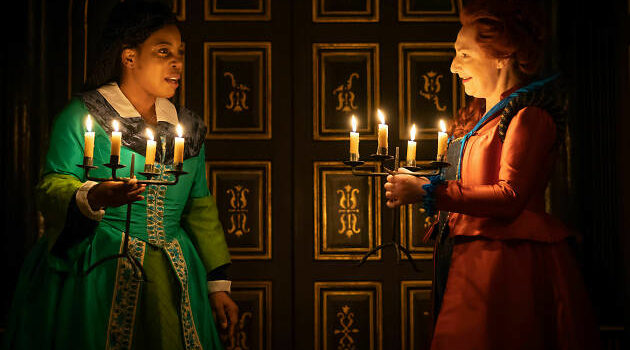
Following the current fashion for changing the gender of characters in plays, in this production both Dr Faustus and Mephistophiles are portrayed by women. I did not feel the play gained from this – but nor did it lose, except inevitably a little in the scene with Helen of Troy. However, in a candle-lit theatre the fact that several characters wore dark-coloured robes meant that visibility at times was poor from seats not close to the stage. There was a lot of shrieking and screaming – to the detriment of Marlowe’s poetry, while failing to enhance the drama. More generally, this production lacked lustre, with rather underwhelming terror in the last speech. I have certainly seen better productions.
Valerie Colin-Russ
The Calvin & Rose G Hoffman Prize
Entries
are now invited for the thirtieth Calvin & Rose G Hoffman Prize
to be awarded in December 2019.
The
closing date for entries to be received is 1st September 2019.
Read More
I clearly remember the sense of resignation when approaching my first read of a Marlowe script. It was a college class assignment of some sort. Wandering through the library stacks seeking a text with readable footnotes, I finally settled on a small single volume of Tamburlaine the Great, part One and cracked it open.
’Resignation’ because after tasting a few Shakespeare plays as an actor and Dramatic Lit major, and scanning a few other Elizabethan playwrights, I knew with all the certainty of a cantankerous young graduate student, that Tamburlaine wouldn’t begin to measure up.
And the first scene didn’t do much to dissuade my prejudice. I labored mightily trying to keep track of the Persians, all the while trying to get a handle on the expansive and flowery language. For someone like myself who came from a heavily ‘realistic’ theatre background, it was all just words. Words, words, words … and more words.
Of course, I wasn’t actually speaking the words that day, or mouthing them. I was ‘reading’ them: silently accumulating and filing them away while waiting for the meaning to form a discernible structure in my young mind.
Not much changed at the start of scene two until, that is, the rhythm of the meter of Tamburlaine’s lines started to pound like a drum. Almost martial, it suggested a quick march tempo. And with that, almost at once, the clarity of the images materialized.
TAMBURLAINE Disdains Zenocrate to live with me? Or you, my lords, to be my followers? Think you I weigh this treasure more than you? Not all the gold in India’s wealthy arms Shall buy the meanest soldier in my train. Zenocrate, lovelier than the love of Jove, Brighter than is the silver Rhodope, Fairer than whitest snow on Scythian hills, Thy person is more worth to Tamburlaine Than the possession of the Persian crown, Which gracious stars have promised at my birth. A hundred tartars shall attend on thee, Mounted on steeds swifter than Pegasus, Thy garments shall be made of Median silk, Encased with precious jewels of mine own, More rich and valorous than Zenocrate’s; With milk-white harts upon an ivory sled Thou shalt be drawn amidst the frozen pools And scale the icy mountains’ lofty tops, Which with thy beauty will be soon resolved; My marital prizes, with five hundred men, Won on the fifty-headed Volga’s waves, Shall all we offer to Zenocrate, And then my self to fair Zenocrate.
The lines roar. The poetry soars. It’s stirring. It’s beautiful. In it I could feel all the youthful energy and hubris of the poet. It’s as if it burst from his very soul. And it got to me, zoink! Like an arrow through the heart. ’This is even better than Shakespeare,’ I thought. ‘Wow. Give me more.’
MENAPHON Your majesty shall shortly have your wish, And ride in triumph through Persepolis.
TAMBURLAINE ‘And ride in triumph through Persepolis’? Is it not brave to be a king, Techelles? Usumcasane and Theridamas, Is it not passing brave to be a king, And ride in triumph through Persepolis’?
And more.
TAMBURLAINE Nature, that framed us of the four elements Warring within our breasts for regiment, Doth teach us all to have aspiring minds: Our souls, whose faculties can comprehend The wondrous architecture of the world And measure every wand’ring planet’s course, Still climbing after knowledge infinite And always moving as the restless spheres, Wills us to wear ourselves and never rest Until we reach that ripest fruit of all, That perfect bliss and sole felicity, The sweet fruition of an earthly crown.
The pounding iambs suggest a tempo that’s fast, almost furious. And when given this speed, the poetry spreads its wings and reveals the beauty inherent in its design and writing. It spews, irresistible, like manna from a great spiritual/sacred fountain.
The meter and the speed of delivery also create another feeling. And that is elation and pleasure at the realization of our shared mastery over the language and the fun inherent in that mastery. We are no longer slaves to the language, but rather masters of it.
Marlowe’s mighty line just tumbles out, accumulating power, building momentum and laying waste to any impulse toward ‘realistic’ speech.
Imagine attending one of those early performances of Tamburlaine and hearing that new language of the theatre for the first time: words and images, like fireworks, spraying the stage, falling relentlessly on your senses. It must have been thrilling. It must have been electric.
Now, unfortunately, I have to ask you to imagine the opposite: dull realistic/conversational readings of iambic pentameter, dripping like sludge oil from one painful moment to the next from the mouths of hesitant, feeble voiced actors.
Such is the production of Macbeth currently running at the Sam Wanamaker Playhouse. Paul Ready, who offers Macbeth as a sniveling coward, even goes so far as to change the meter by adding syllables!
MACBETH And, … and, … and all our yesterdays have lighted fools The way to … to, to … dusty death.
What?! Really?! A stuttering Scotsman?
Aside from the pathetic attempt at conversational relevance, there are many other reasons why this production struck me as dreadful: bad acting all around (are these folks really professionals?); lighting by carried candle; Weird Sisters who are not weird, not ominous, and not to be believed; moronic direction which has Lady Macbeth (the show’s only salvation) delivering most of her lines upstage; a tongue-tied Macduff who can’t fight; and, last but not least, in the climactic fight-to-the-death scene, both Macbeth and Macduff sitting down for a time on little benches whilst they sort things out!
Lay on? I don’t think so. Enough. Enough.
I was at a loss for words. Then, and now. Even more so after I saw that the reviews for the production were generally favorable. What??? Maybe that’s the style the English have now adopted, was all I could conclude. “Mumbling, Bumbling Shakespeare, or, How to Look Like an Idiot While Performing the Classics.” More’s the pity, say I. I’m going back to New York.
Contrast that, if you will, with the electrifying production of “Hamilton” at the Victoria Palace Theatre.
“Hamilton” is written in, and spoken as, ‘rap’. Rap, that peculiar American method of expression that originated and evolved from party DJ’s speaking over their turntable music. The first raps were fairly simple shouts and phrases, but always couched in the crude vernacular of the street. A mode of expression that incorporates the dark, the painful and the dangerous side of ghetto life, rap is literally musical speech. It relies heavily on meter and rhyme. In fact, one could say that rap is an expression of oppression in music, meter and rhyme.
Now, I’m not a fan of rap. I don’t listen to it. I couldn’t begin to tell you of its luminaries or famous works. But what I can tell you is that the ‘rapping’ in Hamilton creates that exact same feeling of joy and wonderment at the language that Marlowe’s mighty line did all those years ago.
It’s fast. It’s non stop. It’s musical. It’s imagistic. The crescendos seem without end. The rap tumbles and rolls and thunders and cracks like lightning. The energy lights up every corner of the theatre. Hamilton is full of mighty lines. It’s built on mighty lines. It’s nothing but mighty lines. Hamilton is the Mighty Line Incarnate.
Granted, Hamilton’s lines are not Marlowe’s mighty iambic lines. No. These rap lines shift and halt and stutter and slither through an ever-changing range of meters. They morph into and out of song, They canter. They gallop. They sing. Now this, now that: whatever serves the purpose of the moment.
But the meter is relentless and the music soaring. And the effect is the same as Marlowe’s: it’s pure joy. Joy from the rhythms, joy from the rhymes, and joy from the mastery over the language. It excites. It uplifts. It fills the theatre with richness and excitement.
The rap of “Hamilton” is as close to Marlowe’s mighty line as you’re likely to hear these days.
James Baffico
Montclair,
New Jersey,
December 2018
The Royal Shakespeare Company (RSC)’s production of Christopher Marlowe’s Tamburlaine was exciting, dramatic, and emotional. The show combined both parts of Marlowe’s seminal play into 200 action-packed minutes.
The staging of the play was minimal but effective. Michael Boyd’s direction used the entire theatre, with supporting players declaiming their lines from the audience. Characters were introduced and their changes in fortune viscerally illustrated with simple costume changes or splashes of blood. We see Tamburlaine decimating king after king, and when Bajazeth (Sagar I M Arya) is wheeled out in an iron cage, you feel the hairs stand on the back of your neck at what could possibly happen next.
Photo by Ellie Kurttz. Copyright RSC
The violent deaths were stylishly graphic, and, combined with the throbbing bass of timpani and orchestral undercurrents, lent to a heightened sense of the macabre.
The eponymous Scythian shepherd played as arrogance personified by Jude Owusu, delivered Marlowe’s beautiful lines with both pomp as well as pain. You fear for Zenocrate (Rosy McEwen) when she pleads for her father’s life, and even hope against hope when, as Callapine, she spurs other kings to rise up against the tyrannical Tamburlaine.
A great supporting cast worked to show how unbridled ambition for power unravels with chilling consequences. Some parts were a little over-acted, but, given the scale of the drama, can be excused since the languid but emotion-logged language towers above everything else – little nuances in quieter scenes and smacking theatregoers in the face during vicissitudinal melodrama.
Jude Owusu as Tamburlaine. Photo copyright of the RSC.
The Royal Shakespeare Company (RSC) has produced at Stratford-on-Avon’s Swan Theatre an impressive Tamburlaine. It is gripping and fast-moving, without losing any of the poetry or meaning.
Jude Owusu, who plays Tamburlaine, is a tall black actor who dominates the stage whenever he appears on it, especially when wearing a glittering gold crown. His towering figure well presents both the monstrous and the magnetically-attractive sides of Tamburlaine.
Rosy McEwen is Zenocrate and she and the many others in the cast are all good.
Part One of the plays is performed before the interval, with Part Two after it. Some cuts give a total performance time of three and a half hours (including the interval).
My guess is that the production will not transfer to London as it would need considerable adaptation from the Swan’s layout to the Barbican theatre. So, see it at Stratford-on-Avon if you can!
Review by Valerie Colin-Russ.
Show Info
Dates: From now until 1 December 2018.
Running Time: 3 hours 2 minutes + 20 minute interval Book Tickets
This year’s Marlowe Lecture will take place at the Rose Theatre, Kingston-upon-Thames at 5 pm, on Saturday, the 24th November.
We are very pleased to say that the lecture will be given by Professor Frank Whately and will be about Marlowe and Edward Alleyn. Those who heard Frank at the Marlowe-Shakespeare Conference in Kingston last November will testify to his brilliance as a communicator. Moreover, the approaching publication of his book on Alleyn makes the event all the more enticing.
A new, epic feature film about Christopher Marlowe, perhaps best remembered as William Shakespeare’s friend and rival, is in the works from British crime film director Greg Hall and producer Gary Kurtz, who is best known for Star Wars and The Empire Strikes Back. Marlowe, while a student at Cambridge University, becomes a spy for the crown and the greatest playwright of his day, but the much darker truth involves real-life intrigue, politics, religion and espionage. Today (May 30) is the 425th anniversary of the tragic early death of Marlowe on this date in 1593, at the age of 29, which has long been assumed to have been because of a fight between friends over a bar bill. In reality, due to his involvement in secret affairs, he was assassinated as a matter of state policy.
A new, epic feature film about Christopher Marlowe, perhaps best remembered as William Shakespeare’s friend and rival, is in the works from British crime film director Greg Hall and producer Gary Kurtz, who is best known for Star Wars and The Empire Strikes Back. Marlowe, while a student at Cambridge University, becomes a spy for the crown and the greatest playwright of his day, but the much darker truth involves real-life intrigue, politics, religion and espionage. May 30th was the 425th anniversary of the tragic early death of Marlowe on this date in 1593, at the age of 29, which has long been assumed to have been because of a fight between friends over a bar bill. In reality, due to his involvement in secret affairs, he was assassinated as a matter of state policy.
The script, by Francis Hamit, details the Elizabethan-era poet and playwright’s other career as a spy for the Crown as part of the early English Secret Service that fought a bitter war with Catholics who wanted Elizabeth I assassinated and Mary, Queen of Scots, placed on the throne instead. Even after Mary was executed, the threat persisted and there was not a day for the rest of her life that Elizabeth did not fear death at Catholic hands. The result was one of the most oppressive tyrannies in history, as Elizabeth’s government sought to control every aspect of English life and culture through law and regulation and enforced the government’s policies through an extensive system of spies and censorship. Marlowe’s own rebellion included preaching atheism and openly bragging about his own homosexuality at a time when other men were burned at the stake for it.
The most famous playwright of his day, he was too well-known and popular to be tried and executed publicly; Queen Elizabeth ordered him secretly assassinated by his fellow secret service agents. Only recently have academic researchers uncovered the truth.
“Marlowe is a tragic figure, undone by his own fatal flaws,” Francis Hamit said. “Despite the passage of time, it is a story which will resonate with today’s audiences.”
Greg Hall added, “The storyline is quite dynamic. It’s more about the secret underworld of spies and criminals that Kit Marlowe embraced at the same time he was social climbing with very prominent men such as Sir Walter Raleigh and Sir Francis Walsingham, the Secretary of State, and the most powerful man in England. It is going to be a very exciting production and we are casting it now.”
Plans are to make the film mostly in Wales this fall. North American distribution has been assigned to Lightyear Entertainment in Los Angeles. Among Lightyear’s theatrical releases was Tanna, which was nominated for an Academy Award for Best Foreign Language Film in 2017.
Arnie Holland, Lightyear’s CEO, is an Executive Producer of the film. Other Executive Producers include Michael John Donahue and Craig Miller, CEO of Wolfmill Entertainment.
Director Greg Hall came to early notice with his breakthrough debut drama The Plague, made on a shoestring budget but eliciting the support of industry stalwarts such as Mike Leigh who awarded Hall the Katrin Cartlidge Foundation scholarship. He has gone on to make a name for himself as an independent filmmaker on the rise with six feature films under his belt and a growing domestic and international audience. Hall specializes in strong dramatic performances, visual flare and often a focus in the crime genre.
Producer Gary Kurtz is an American film producer whose list of credits includes American Graffiti, Star Wars, The Empire Strikes Back, The Dark Crystal and Return to Oz.
Writer Francis Hamit is a graduate of the world-famous Iowa Writers Workshop, has published two historical spy novels set at the time of the American Civil War and is working on a memoir about military intelligence during the Vietnam War. After Christopher Marlowe, his next project will be a film or limited-run television series about Belle Boyd, the protagonist in Hamit’s 2008 novel The Shenandoah Spy.
On a bright May morning we gathered in the foyer of The Marlowe Theatre and then made our way to The Marlowe Kit, where the Chairman, Professor Ken Pickering, informed us that Marlowe would have walked past the former Poor Priests’ Hospital, as his only extant signature was found in the building next door. Ken then read one of Marlowe’s lesser-known but charming poems: ‘I walk’d along a stream, for pureness rare.’ This was very fitting as The Kit is next to the river Stour, and we later threw flowers and rosemary into the water in his memory.
Music
One of the highlights of the day was listening to sections of Purcell’s ‘The Faerie Queen’ by the Marlowe Consort led by John Perfect. The libretto is an adaptation of A Midsummer Night’s Dream, but the music was used independently of the play during scene changes, as they didn’t normally raise the curtain between acts. The fairies were originally played by 8-year olds, and it was possible to imagine them dancing on the stage to the lively melody.
Acting Shakespeare by Frank Barrie
It was a real treat and a great pleasure to hear Frank Barrie give a talk about some of the highlights of his long and distinguished acting career. Frank has worked with the most iconic names in British theatre, starred in 36 productions of Shakespeare plays in 67 countries, was a leading member of Laurence Olivier’s National Theatre Company at the Old Vic, and has made over 200 TV appearances.
Frank said that he admires Shakespeare because he expresses every emotion in the most beautiful and exact language, and his characters are so alive and real, more so than many people we meet. He particularly enjoyed playing Hamlet because everyone can identify with him. Similarly, the story of Macbeth’s rise and fall has connected with audiences in many places over the last 400 years. For example, Frank told us about his performance of Macbeth in Baghdad during the rule of Saddam Hussein. At first, the audience did not take the play very seriously; they were shouting, joining in, walking in front of the stage and responding to impressive acting points. However, when they realised what the play was about and how it related to their own lives, they went quiet and there was a huge applause at the end. The next day crowds of people arrived to see the performance, as word of its significance had spread quickly. Unfortunately, the secret police were in the audience this time, and the company was forbidden from performing the Scottish playagain because it was considered to be too dangerous – a sign of the extraordinary power of Shakespeare to communicate with modern audiences.
On a lighter note, Frank gave a series of fantastic performances and entertaining anecdotes about an onstage swordfight that went wrong, a bomb exploding outside the theatre, and a collapsing bed!
Lunch
Lunch was served at an excellent restaurant in a peaceful riverside setting.
Grotowski directs Dr Faustus by Professor Paul Allain
Paul Allain started his informative talk by describing the different phases of the Polish film director’s career and the ideas behind his work, in particular ‘Poor Theatre’, which focuses simply on the relationship between the actor and spectator. Actors trained in this method concentrate less on techniques and more on revealing their true selves through the role.
Paul explained that people were astounded by Grotowski’s ground-breaking production of Doctor Faustus in 1963 and it received mixed reviews, with one British critic finding it ‘uncomfortable’. The 9 minute film of the play helped us to understand why it was so challenging: the rehearsals and performance were clearly very physically and emotionally taxing for the actors, and the spectators were in an intimate space with the protagonist, for example sitting at tables at Faustus’ Last Supper. Faustus was played as a blasphemous, Christ-like figure. The film captured the sinister atmosphere in the theatre, and many of us were struck by the way Mephistopheles was presented as an ambiguous mixture of male and female, good and evil. It is clearly still a very thought-provoking production!
Directing Edward II – a discussion with Ricky Dukes and Dr Geoff Doel
Ricky Dukes is the Artistic Director of the Lazarus Theatre Company and he recently directed Edward II at venues including the Greenwich Theatre. Many members of the Society had seen the performances, but there were photos for those who hadn’t. Ricky talked us through how the company made decisions about the staging of Marlowe’s history play, for instance the creative ideas they considered and rejected and the conversations about which sections to cut or include in the 90 minutes running time. They decided on a Brechtian design, set in the context of harsh, masculine, brutal England, and the relationship between Edward and Gaveston was portrayed in a sympathetic light.
Geoff Doel started the discussion by asking Ricky to explain some of his directing choices. Geoff disagreed with many of those choices, and this sparked a larger, robust debate with Ken, Jo and members of the audience. The discussion was essentially about ‘modern’ vs ‘traditional’ staging and interpretations, and it continued well after Marlowe Day had finished! Drama is based on conflict, so this was a very apt end to the day!
The rights to the 1991 drama, Edward II by Derek Jarman, have been nabbed by distributor; Film Movement. They are set to give this fantastic story, based on the 16th century play, a limited theatrical run in North America and a release on digital formats.
The film stars Steven Waddington and Tilda Swinton in modern day England as Edward II and Isabella respectivley. The film centres around Britian’s only openly gay monarch, originally written as a play by our very own Christopher Marlowe.