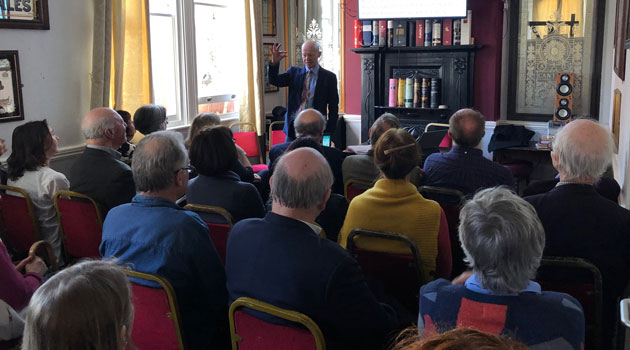
London Marlowe Day took place on the 24th February, 2018 at the King & Queen Pub in London. After the AGM of the Marlowe Society, there were several interesting talks, sharing of information and news items, and a delicious fish and chips lunch.
AGM
We commenced with reports from members of the committee and then moved on to the election of officers. The details of the elections can be found in the Chairman’s Spring Letter. Ken Pickering filled us in on exciting plans to move our library at Faversham to the new Marlowe Kit in Canterbury. We also heard from Julian Ng about his ideas for the future of the website, including how he will be using his marketing expertise to help promote and raise funds for the Society.
Malcolm Elliott’s Christopher Shakespeare: the man behind the plays
Following the AGM, Malcolm Elliott, historian, lecturer, Quaker and Marlowe Society member gave a talk about his book Christopher Shakespeare: the man behind the plays. Elliott explained that Marlowe did not die in Deptford in 1593, but lived the rest of his life undercover, and wrote the sonnets and plays normally attributed to Shakespeare when he was in exile abroad. Some sonnets appear to describe Marlowe’s feelings on his travels across Europe, as he laments the loss of his friends and Walsingham in particular. Elliott also asserts in the book that only someone with intimate knowledge of the French court of Navarre and cities in northern Italy could have written Love’s Labour’s Lost, Romeo and Juliet, The Taming of the Shrew, The Two Gentlemen of Verona and The Merchant of Venice. One particularly intriguing claim is that no one in England knew of Don Virginio Orsino, Duke of Bracciano’s presence in England until two weeks before Twelfth Night was performed for him and the Queen on 6 January 1601, so it is inconceivable that Shakespeare could have written it at such short notice. It seems more likely that Marlowe, who was probably in the service of Bracciano and knew of the visit in advance, wrote the play. If Marlowe accompanied the trip to England, he would have been in disguise for his own safety, and disguise is a familiar theme in plays thought to be written by Shakespeare.
After the talk, there was a question and answer session. However, the end of the talk felt like a beginning for me, as I’m sure the book could stimulate more research, particularly on who was working at the famous French and Italian courts when these plays were written.
Fish and Chip lunch
The lunch was enjoyed by all and was a great opportunity to discuss ideas about the forward-thinking plans for the Society outlined in the AGM and also the implications of Malcolm’s book.
Dr Ildiko Solti’s talk: ‘The Politics of the Bear-Pit: Marlowe and Shakespeare in shared light’
Dr Solti, a long-standing member of the Marlowe Society and Fellow of Kingston University, explored how Marlowe and Shakespeare used theatrical space and how they worked the audience.
Ildiko started her talk by explaining how animal baiting pits full of blood and adrenaline in the morning were transformed into theatres in the afternoon. The level of excitement remained in the theatre because it was (and still is) a marked space with daily life outside and different rules inside. During the talk we were encouraged to really think about how we might explore a space when we enter into it, like a curious but apprehensive animal would when it comes out of its hole and looks around a new area. In a theatre we can experience that primitive ‘fight or flight’ instinct because as an audience member you could feel uncomfortable – perhaps as a confidante, implicated in the action, or you may feel provoked by the action. Marlowe seems to enjoy stretching and challenging his audience by a preference for the outrageous, and involving them in impossible-to-solve moral dilemmas.
Dr Solti suggested that a great way of fully understanding what it was like to walk into an Elizabethan theatre and enjoy the feeling of being immersed it, is to watch the film Shakespeare in Love. The theatrical space is so important because it shapes the meaning of the play and, of course, the most important moment can be inarticulate. Similarly, movement can construct meaning, rather than just be illustrative of it. The talk was a real eye-opener and it helped us to understand that Marlowe was a true master of space, not just the mighty line.
International developments
During the day we heard about performances of Doctor Faustus at the University of Malta and in Brazil. Marlowe’s fame is clearly growing around the world! It was also interesting to hear about the new Shakespeare Theatre in Gdańsk, Poland, which is built on the site of a 17th century theatre, known as the Fencing School, where English travelling players performed.
Event Photos

Professor Ken Pickering (centre) with Malcolm Elliot (holding his book ‘Christopher Shakespeare’) and Dr Ildiko Solti.


Dr Ildiko Solti presenting an interesting insight into how theatres worked in Elizabethan times.


A representative sharing all the exciting changes for The Rose Theatre Bankside.